It is probably the worst historical moment for Mexico.

Painting of Tomás Gómez Robledo, 2010
The art exhibition Sentón y Bicentón, Ni Revolución Ni Independencia pays attention to this very sad moment in Mexico's history.
With work of: Oscar Bächtold / Maribel Avilés / Oscar Ojeda / Vicky González / Tomás Gómez Robledo / Alejandra Barrera / Alicia Amador / Rebeca Martínez / José Barbosa / Anne Pivron / Norma Ascencio / Marisa Polin / Jerónimo Vázquez/ Anibal Delgado/ Isabel Ramos Flota / Rosario Ochoa / Lorena Mata / Mónica Polin
The opening is Thursday 9 September at 8 pm at
Peces Centro Histórico, Regina 49, Centro, México DF

Painting of Phil Kelly, 2009
Exactly 200 years ago New Spain separatists-insurgents' got its independence from Spain forming the new country of Mexico. 100 years later a civil war started where millions of Mexicans died. After this revolution Mexico started a new era without Porfirio Diaz, with a new constitution and with a new political party (later to become the infamous PRI).
So the Mexican government thought a few years ago, let's celebrate and conmemorate this dates in a big big way! Let's bring down the house (Echar la casa por la ventana)!
For decades, the poorer citizens had not had access to the basic rights like education and health. All these are allowing a bigger, if not the deepest, income disparity that in consequence created a social and economical bomb that exploded in a drug and crime society in large parts of the country.
The present president, Felipe Calderon, thought at the beginning of his mandate to cut this problem from the bottom. The government started a military offensive on the drug cartels becoming a War on Drugs.
After 3 and a half years and nearly 30 000 executed! people, the country is far behind than when this started. The future has never seemed more somber than now. And exactly now is that the beautiful round numbers of 200 and 100 are to be celebrated.
Maybe it is not by chance that Mexico is celebrating two of the most cruel periods in the history of Mexico within 'the frame' of the new third bloody and amoral of all: The Narco War.
There is a lot of indignation on this extremely badly timed (and expensive) festivities.

Painting of Marisa Polin, La Revolucion de la Narco Independencia, 2010
Some reading: Victor Beltri, PBS, AguaFiestas.

Painting of Tomás Gómez Robledo, 2010
The art exhibition Sentón y Bicentón, Ni Revolución Ni Independencia pays attention to this very sad moment in Mexico's history.
With work of: Oscar Bächtold / Maribel Avilés / Oscar Ojeda / Vicky González / Tomás Gómez Robledo / Alejandra Barrera / Alicia Amador / Rebeca Martínez / José Barbosa / Anne Pivron / Norma Ascencio / Marisa Polin / Jerónimo Vázquez/ Anibal Delgado/ Isabel Ramos Flota / Rosario Ochoa / Lorena Mata / Mónica Polin
The opening is Thursday 9 September at 8 pm at
Peces Centro Histórico, Regina 49, Centro, México DF

Painting of Phil Kelly, 2009
Exactly 200 years ago New Spain separatists-insurgents' got its independence from Spain forming the new country of Mexico. 100 years later a civil war started where millions of Mexicans died. After this revolution Mexico started a new era without Porfirio Diaz, with a new constitution and with a new political party (later to become the infamous PRI).
So the Mexican government thought a few years ago, let's celebrate and conmemorate this dates in a big big way! Let's bring down the house (Echar la casa por la ventana)!
For decades, the poorer citizens had not had access to the basic rights like education and health. All these are allowing a bigger, if not the deepest, income disparity that in consequence created a social and economical bomb that exploded in a drug and crime society in large parts of the country.
The present president, Felipe Calderon, thought at the beginning of his mandate to cut this problem from the bottom. The government started a military offensive on the drug cartels becoming a War on Drugs.
After 3 and a half years and nearly 30 000 executed! people, the country is far behind than when this started. The future has never seemed more somber than now. And exactly now is that the beautiful round numbers of 200 and 100 are to be celebrated.
Maybe it is not by chance that Mexico is celebrating two of the most cruel periods in the history of Mexico within 'the frame' of the new third bloody and amoral of all: The Narco War.
There is a lot of indignation on this extremely badly timed (and expensive) festivities.
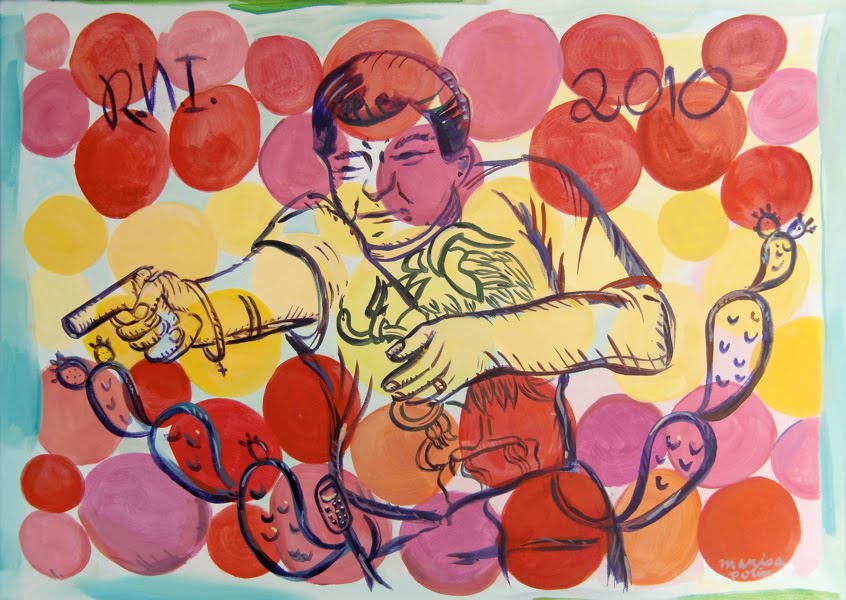
Painting of Marisa Polin, La Revolucion de la Narco Independencia, 2010
Some reading: Victor Beltri, PBS, AguaFiestas.