Showing posts sorted by relevance for query mexico. Sort by date Show all posts

31 August 2010

What is there to celebrate?

It is probably the worst historical moment for Mexico.

Painting of Tomás Gómez Robledo, 2010
The art exhibition Sentón y Bicentón, Ni Revolución Ni Independencia pays attention to this very sad moment in Mexico's history.
With work of: Oscar Bächtold / Maribel Avilés / Oscar Ojeda / Vicky González / Tomás Gómez Robledo / Alejandra Barrera / Alicia Amador / Rebeca Martínez / José Barbosa / Anne Pivron / Norma Ascencio / Marisa Polin / Jerónimo Vázquez/ Anibal Delgado/ Isabel Ramos Flota / Rosario Ochoa / Lorena Mata / Mónica Polin
The opening is Thursday 9 September at 8 pm at
Peces Centro Histórico, Regina 49, Centro, México DF

Painting of Phil Kelly, 2009
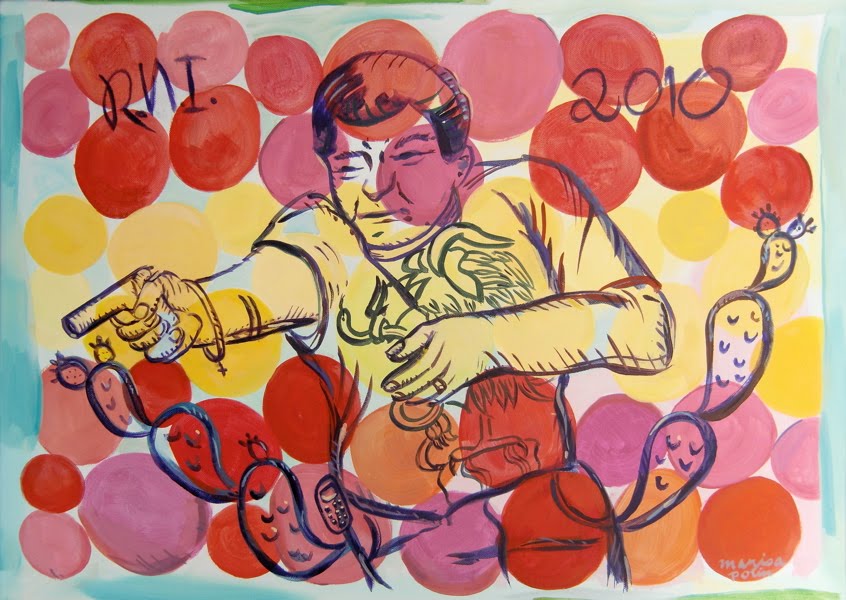
Exactly 200 years ago New Spain separatists-insurgents' got its independence from Spain forming the new country of Mexico. 100 years later a civil war started where millions of Mexicans died. After this revolution Mexico started a new era without Porfirio Diaz, with a new constitution and with a new political party (later to become the infamous PRI).
So the Mexican government thought a few years ago, let's celebrate and conmemorate this dates in a big big way! Let's bring down the house (Echar la casa por la ventana)!
For decades, the poorer citizens had not had access to the basic rights like education and health. All these are allowing a bigger, if not the deepest, income disparity that in consequence created a social and economical bomb that exploded in a drug and crime society in large parts of the country.
The present president, Felipe Calderon, thought at the beginning of his mandate to cut this problem from the bottom. The government started a military offensive on the drug cartels becoming a War on Drugs.
After 3 and a half years and nearly 30 000 executed! people, the country is far behind than when this started. The future has never seemed more somber than now. And exactly now is that the beautiful round numbers of 200 and 100 are to be celebrated.
Maybe it is not by chance that Mexico is celebrating two of the most cruel periods in the history of Mexico within 'the frame' of the new third bloody and amoral of all: The Narco War.
There is a lot of indignation on this extremely badly timed (and expensive) festivities.

Painting of Marisa Polin, La Revolucion de la Narco Independencia, 2010
Some reading: Victor Beltri, PBS, AguaFiestas.

11 June 2006

A portrait's history


When I got the commission to paint 4 portraits for the covers of the magazine Vrij Nederland we all had no idea who would they all be. As it was an intense (short lasted) political turmoil at that moment I thought I was going to paint some of the national political figures. The first was going to be Tom Barman from whom I only knew the name of his band (dEUS) at that moment, but by now after seeing all his interviews, photographs and listening to nearly all his music I became an instant connoisseur at Barman matters.
The second portrait:
When Edzard Mik from the magazine told me that I would be painting the Dutch crown prince Willem-Alexander, around the theme sport and football supporters in relation to the football world cup, I started laughing. He is of course a known sports fan and member of the International Olympic Committee. But it was not for me the first person I thought I would be painting, specially considering that the other painting I made of him on 1996 (made by invitation too) I based my portrait on the at that moment just finished Atlanta Olympic Games, where he was in a way criticised for being "to mortal" among the Dutch sporters and showing all his enthusiasm. So I called this painting "Call me Billy please!” At that time I didn't know he was called Alexander at home, and then the title would have been different. I tried to portray his 'trying to be normal' side of his.
This portrait, by chance was published on the cover page of the newspaper Volkskrant, so later that autumn when I had an exhibition at the Chopo Museum in Mexico City and the then 'nearly' Dutch ambassador to Mexico, Jan Jaap van der Velde told me that he had seen that work on the newspaper, and asked me why I had not brought it to Mexico. I had not even thought about it. Any way, my husband brought it later and it hanged prominently at the museum. Jan Jaap really liked it and asked his ministry to buy it. Foreign Affairs bought it and he regretted it not having bought it himself. After being posted to Libya he finally came back to Mexico as ambassador looking forward to see 'his' painting back. He brought it back to his office and just one month ago as I was in Mexico and I visited the new embassy for the first time I saw the painting for the first time after 10 years and we made a photo together.
Since 1996 I have made only now and then portraits I have had many other themes. Since three years ago I have committed myself to the Portrait theme as I wanted to discover and learn as much as possible about it and was intrigued by the possibilities of it.
And now I go back not only to portraits but to the sporty side of the prince Willem Alexander.

On the third photo de ambassador and I in may 2006.
On the last photo is the champion cyclist Leontien van Moorsel, as she celebrates the achievement of an important record in 2003 in Mexico next to HE Jan-Jaap van der Velde. The painting is at the back.

21 October 2010

The Paint and the Blood

This is an article written by art critic Jimenez Abarca on the paintings from the exhibition Bella and Terca and those from my exhibition (Not) Guilty:

The Paint and the Blood
by Juan Carlos Jiménez Abarca
Mir(i)ada
Published at the Suplemento of Letras de Cambio from the newspaper Cambio de Michoacán
17 October 2010
(Original in Spanish via Google translate)
Mask XI (2008), Gustavo Monroy, cover of the magazine Proceso, number 1771, October 2010, Marisa Polin and Slice (2008) oil on canvas, Omar Rodriguez-Graham.

Numerous magazines in our country pay attention to the political themes with in- depth journalism articles. Less abundant are the magazines of this type that include articles of art criticism or opinion on areas of culture in its content. But few are those who devote the cover and main article in the publication of the work of a Mexican painter, even though that article has only 5 pages long and many pictures, so that reading is actually a few words to go.
The number 1771 of Proceso magazine, which corresponds to October this year, shows on its cover a pictorial version of the photograph taken of Diego Fernandez de Cevallos by their captors, distributed on 26 September in the national newspapers. The title of the magazine is: Art of Today’s Mexico.

The author is Marisa Polin, a Mexican who has lived 20 years in The Netherlands, and the image corresponds to the series (Not) Guilty, on display at World Art Delft (WAD) in the city of Delft. The exhibition is on display from 12 September until 31 October. In the words of Marco Appel, the Proceso journalist, this is "one of the most provocative exhibitions that have taken place in Holland with Mexican violence as a theme." We have to know how many exhibitions have been made in this country with the Mexican violence as theme to verify that, indeed, if it is the most provocative of all. The reporter's comment could had been left out.
The painting The Boss has as origin the impression caused to Polin by the photograph of Diego Fernandez for a double symbolism: “on the one hand, the representation of a man aged and impotent in front of his tragic situation, and secondly, the arrogant politician and robust than is reflected at the cover of Proceso. It is the image of humiliation." The rest of the works bear the same tone: things that are published in the media and no one wants to see, like a subject bound by hands and feet just thrown from a car, a naked man sitting on a chair with his arms tied to the back, with lost eyes and a slight smile, mysterious, mainly by the letter "Z" carved into his flesh up to the chest: he is dead.
Other are images that are fatefully familiar: virgins and other religious images in the grips of the pistols used by gunmen, a soldier (or two officers) presenting a man, guarding the caught objects: weapons, ammunition, drugs and more.
I must say. It is a plastic proposal, in its economy of line and color contrast, shows an aesthetic vision of something that politically almost nobody wants to be shown abroad Mexico, particularly the federal government and diplomats, including Ambassador Jorge Lomonaco in The Netherlands. He said that there were no newspaper articles about the exhibition and it has gone unnoticed, leaving no impact on the country. But the fact that Polin paintings are going to be exhibited soon in the Gallery Ruimtevaart in The Hague makes you think about the cultural consumption of these images.
In Mexico there are other painters who incorporate social issues and rawness in their work, creating a beautification of violence, acquiring a bewildering emotional quality. Two of them exhibited last July at the Museum of Modern Art (Mexico City) Bella and Terca, nine arguments about painting.
The show could be read as the work of Gustavo Monroy,"involves the use of invoices and compositions, sometimes associated with narrative style of late medieval painting, or sometimes mystical theatrical Baroque religious painting, to exalt the drama and the iconic force of topics from current news of our country.” A Last ‘Mexican’ Supper is a table with tablecloth that brings together twelve bloodied heads without their bodies, Mexico Lindo y Querido shows a national emblem on the decapitated portrait of the painter. He himself suicidally points to his head while carrying a plastic mask of former President Salinas de Gortari in Table XI Mask (2008).
Monroy constructs symbols over the violent reality experienced by our country. In an interview in 2009, commented that given the social reality that he noticed in the present-day -reported reading 3 different newspapers-, could not base his artwork in blowing up balloons and exhibiting them at the museum.
The second artist is Omar Rodriguez-Graham. His case is no less political by his social themes in its work: showing mutilated female bodies located in the morgue. A wall text reads: "In the paintings of Omar Rodriguez-Graham is shown the expression of the paint with a spatula or with masses of pigment, he is working with the construction of forms that are self contained and achieve a large monumental composition with high impact. This tectonic violence of the human forms -bounded by a sophisticated frame- shifts the criminal theme of the work to a non-narrative territory of refined sensuousness." In other words, distance to what otherwise would seem horrible and intolerable; through the beautification of the violent image, the gaze goes to the neck of a young, pale and dead woman and you may continue to watch. What we see is a picture that would show everything with absolute realism, but constructed of colors, shapes, textures and gestural strokes.
"Many people think that my work tries to present or criticize the violence. These people are wrong because it fails to see the painting as more than an image. My work is painting and not image.” The words of Omar Rodriguez about his work resemble those of Marisa Polin talking about her paintings: "It has an aesthetic goal. It is an abstraction of what is happening in Mexico. I am describing a very cruel act. You approach the form with curiosity, it is beautiful, economical on lines. Only in a second or third moment you realize what it is, and you can not deny what you see ... "

The original text at newspaper Cambio de Michoacán

More texts from the press.

02 October 2010

The violence, the press and the impression


Click on the photo
Exhiben en Holanda violencia mexicana, bij Inder Bugarin.
Article on the Mexican newspaper Reforma of 2 October 2010 on the exhibition (Not) Guilty at World Art Delft and not as the subtitle of the article says incorrectly that the exhibition is at the embassy.

Here is the painting The Boss -El Jefe- (Diego Fernández de Cevallos) as it is now, just finished.

(Via Google Translation)
Mexican violence exhibited in The Netherlands

The exhibition shows the kidnapping of Diego Fernandez de Ceballos.

The Embassy of Mexico in Holland mounted an exhibition that portrays the unkind face of Country

Inder Bugarin / Correspondent

Brussels, Belgium (October 2, 2010) .- As part of the Bicentennial of Independence, the Embassy of Mexico in Netherlands promotes a painting exhibition titled "(Not) Guilty" of the Mexican artist Marisa Polin, which portrays the upsurge of violence in the country.

Consisting of 40 paintings and drawings, including 13 dedicated to the explosion of violence and drug trafficking, the exhibition takes place in the WAD, a cultural center of the city of Delft.

Among the drawings shows the head of a decapitated, narco messages and the portrait of a member of Los Zetas tortured, and a guy blindfolded and with hands tied behind. It also appears the portrait of Diego Fernandez de Cevallos kidnapped, who said the artist, represents the view of the plot, lack of truth and contradictory versions of the official discourse.

The exhibition is made possible with support from the Foundation Stroom in The Hague and the Embassy of Mexico in Netherlands was responsible for the publicity of the event shown in the official cultural program aimed at spreading the country's presence in the Netherlands.

The Ambassador of Mexico in the Netherlands, Jorge Lomonaco, said to Reforma, that because the work is not part of the official events financed and planned by the SRE, Mexico was not informed for approval of its distribution, and report the results

"There is a Mexican artist who has a statement which has recognition in certain circles, and what we do is inform the community that there is this exhibition of Mexican artist," said the ambassador when asked about the motivation to spread a event that reflects the climate of insecurity in the country.

The exhibition will conclude on October 17.

My note: The exhibition is not organized or shown by or at the embassy.

18 November 2008

Museo Universitario Arte Contemporáneo (MUAC)

The best art news in Mexico in years. A great museum in one of my favorite places on earth. I am very lucky that I will be visiting it as soon as next month!

Museo Universitario Arte Contemporáneo (MUAC), Mexico City's
opens November 26th, 2008
Info on the openings' exhibitions.

Ciudad Universitaria is the main campus of the Universidad Nacional Autónoma de México, the largest university in Latin America (300,000 students).
The impressive new building, in the University's Cultural Center, was designed by internationally renowned Mexican Architect Teodoro González de León, (the Campus was declared World Heritage in 2007). Embedded in the volcanic lava landscape that characterizes this area in the deep South of Mexico City is the handsome 13,000 M2 two-story building.
Following a proposal authored by Olivier Debroise, the MUAC created an acquisitions program for the Collection that covers a broad historical spectrum, beginning with works rescued from the time of the construction of the Campus in 1952. This ongoing project brings together not only a survey of the fragmented tendencies of the last 50 years of Mexican production - it has also established a permanent agreement with two of Mexico's most respected international collectors – the Corpus Group and the Charpenel Collections - to enhance the dialogue with global experience.
Museum's founding Director: Graciela de la Torre
Curatorial program team: Guillermo Santamarina and José Luis Barrios.

MUSEO UNIVERSITARIO ARTE CONTEMPORÁNEO – MUAC
Ciudad Universitaria, Mexico City
info@muac.unam.mx
from E-flux

More news on Muac.
More: Replica 21, article in Spanish.

18 July 2011

Mexico meets Berlin

Iván Abreu
Marisa Polin
Heriberto Quesnel
Mexiko trifft Berlin
A group exhibition of five Mexican artists at EMERSON Gallery in Berlin: 

Iván Abreu, Vanessa Farfán, Lucero Hernández, Marisa Polin, Heriberto Quesnel.

Opening:  22.07.11   7pm
Exhibition:  23.07.2011 - 04. 09.2011
Tuesday -Friday  2 -7 pm.

-Iván Abreu (La Habana Cuba 1967). Video, drawings, performance.
Iván Abreu's work articulates art, design and technology by using multiple media such as electronic devices, software development, sound experimentation, Internet, industrial design, documents, video and photography. For Abreu the use of technology as an artistic strategy allows the coupling of situations that were not designed to operate together to create singular effects. Technology activates these unions in art that in referencing social and political, transforms relations from cause and effect to cause and consequence.
-Vanessa Farfán (Mexico City 1977). Painting, installation.
Using different media as paint, threats, fabric and objects, her works show the result of situations created by intention or by accident. Structured spaces are transgressed by the movement of the elements which live in there. For Farfán, the relation space+time=movement is an important formula in her work.
-Lucero Hernández (Jalisco, México 1980). Installation, performance.
The women's murders in Ciudad Juárez, the role of the women in the Mexican society and the cultural shock are the topics of Lucero's work. In her performances, Hernández takes part of the Mexican everyday life and she places it out of context,making the meaning of this "Mexican situations" stronger.
-Marisa Polin (Mexico City 1965). Painting.
Images from newspapers and publications are reinterpreted in paintings. The work of Polin makes a synthesis of the weak and strong points of contemporary Mexico, always with a critical point of view.
-Heriberto Quesnel (Mexico City 1971). Painting, collage.
Critic of the social behavior through the cultures , Heriberto uses humor to point out the terrifying situations
of the political and social structures nowadays. He uses commercial, social, cultural or political icons to play around the context and the meaning of them.

EMERSON Gallery 
Gartenstr. 1, 10115 Berlin / (030) 24 04 72 95 /
info@emersongallery.de  / http://www.emerson-gallery.de/
Tue-Fr   2 - 7 pm
Do you want to see my working studio? Trendbeheer.


24 December 2010

Drugs culture kidnaps the fine arts

El Economista, image El Jefe by M.Polin
This article talks about the influence of the Mexican Drugs War in the arts, days after the "official" release of the ex-presidential candidate and lawyer Diego Fernandez de Cevallos. He was kidnapped for 7 months. This information is in part what the title of the article by Vicente Gutierrez from El Economista is refering to. The image of the article is my painting El Jefe based on the photo made of Fernandez de Cevallos by his kidnappers.


English Excerpt from: 
The narco kidnaps the fine arts
Vicente Gutiérrez / El Economista, Mexico / 22 December 2010

Film, theater, art installations, music, novels, art and television series are inspired by drug trafficking and violence in Mexico to create works of art. But the narco goes beyond the social phenomenon that causes the lifestyles of drug dealers, that many  that many young people copy in their dream to be rich like them. Increasingly, the artists take the drugs world as a theme to create.
"It is impossible to ignore the horror that exists in many cities, borders and roads of the country and this affects all activities or people," said the writer Martin Solares.
"In Mexico's artists have begun to reflect on their creations the increasing daily violence or the presence of drug traffickers. Even in the Mexican poems and novels  occasionally appears a testament to the violence! "He said. After the federal government declared war on drug trafficking, the issue has been more present than ever in the Fine Arts and has become the "tough" face of Mexico in the world.  Just remember that for the 53 Venice Biennale, the artist Teresa Margolles showed an installation of a room soaked with blood and debris of various murders and had jewelry made with scrap from the drugs war.
The art curator Cuauhtémoc Medina explained that "jewelry made from fragments of windshield glass, embroidered in gold on blood and sound recordings of the landscapes of death aphorisms murderers, they all converge to produce a space for reflection, physical threat and anxiety."
Or what the artist Marisa Polin did in The Netherlands, who intervened a picture of Diego Fernandez de Cevallos blindfolded. Although this was the most innocent part of the exhibition where executions, beheaded, tortured and kidnapped were shown in her drawings and paintings that raised a lot of noise.
What about El Infierno / The Hell, Luis Estrada film which grossed 83 million 82 thousand 542 pesos to register as the second highest grossing film in Mexican cinema in 2010 which tells the story of an ordinary man who ends up as a drug trafficker.
etcetera...  
 
Excerpto en Español de: La narcocultura secuestra las bellas artes
Vicente Gutiérrez / El Economista, Mexico / 22 December 2010
Cine, obras de teatro, instalaciones de arte, música, novelas, artes plásticas y series de televisión se inspiran en el narcotráfico y la violencia en México para crear obras artísticas.
Pero la narcocultura va más allá del fenómeno social que provoca el estilo de vida de los narcotraficantes, ése que muchos jóvenes copian en su sueño por ser ricos como ellos.
Cada vez más, los artistas toman el narco como materia para crear.
“Es imposible ignorar el horror que se vive en tantas ciudades, fronteras o carreteras del país y esto afecta a todas las actividades o personas”, explicó el escritor Martín Solares.
“En México los artistas más exquisitos y solipsistas han comenzado a reflejar en sus creaciones el aumento de la violencia cotidiana o la presencia de los narcotraficantes. ¡Hasta en los poemas y en las novelas de ciencia ficción mexicanas aparece de vez en cuando un testimonio de la violencia!”, agregó. Después de que el gobierno federal declaró la guerra al narcotráfico, el tema ha estado más presente que nunca en las Bellas Artes y se ha convertido en el rostro “duro” de México en el mundo. Basta recordar que para la 53 Bienal de Venecia, la artista Teresa Margolles presentó instalaciones sobre el narco con una habitación empapada con sangre, residuos de distintos asesinatos y joyas hechas con desechos de la guerra del narcotráfico.
El curador de arte Cuauhtémoc Medina explicó que “joyas hechas con fragmentos de parabrisas, aforismos asesinos bordados en oro sobre sangre, sonidos grabados en los paisajes de la muerte, todos ellos convergen para producir un espacio de reflexión, amenaza corporal y ansiedad”.
O lo que hizo en Holanda la artista plástica Marisa Polin quien intervino una foto de Diego Fernández de Cevallos con los ojos vendados, aunque es la pieza más inocente de la exposición ante los ejecutados, decapitados, torturados y secuestrados que aparecen en sus dibujos y pinturas que levantaron mucho ruido.
Qué decir de El Infierno, película de Luis Estrada que recaudó 83 millones 82 mil 542 pesos para colocarse como la segunda cinta más taquillera del cine mexicano en el 2010 donde relata la historia de un hombre común que acaba como narcotraficante.

23 January 2009

IkSamen


Ximena Dávalos

Emilio Sánchez

Liseth Rodriguez
On the last day of the exhibition of Latin American artists: IkSamen in The Hague.
Adelina Reyes Zacatecas, Mexico / Alejandra Nettel, Mexico / Liseth Rodriguez, El Salvador /
Vanessa García, Mexico / Emilio Sánchez, Mexico / Ximena Dávalos, Ecuador
More info: Culturales and Galerie BCOM

20 January 2010

One more visit to Mexico expected/unexpected

More of Mexico expected/unexpected at Stedelijk Museum Schiedam
last days!


A great guided visit by Jose Springer, cultural attache of Mexico in The Netherlands.

Mexico vs Brazil 24-0!

Students from the Rietveld Academy.


In front of Francis Alys.

02 September 2007

ID igital

Digital (self)portraits from Sandra's ' friends' chat page.

Each person makes a choice on how he or she wants to be shown to the world.

After being encouraged to join one of the popular chat sites I discovered that my chosen (self) portrait for my ID tag was a rather standard pose in this fifth dimension digital world. Soon I landed at Sandra's page and her
' friends'. There were many things related to her young, city, middle class life and some other signs are better described as global. Among the photos of her friends there were some very inspiring and many caused me a lot of surprise. The biggest impression to me was the "I want to belong" signs. Why would any one show a group photo when placing an image of them? By the number of group photo’s I noticed that this was common use. On the other side, showing a photo of yourself with your partner gives a clear sign of possession. There was plenty of theatre too: I believe some were so sure or unsure of themselves and, I feel confident to say, they were just playing the opposite.
After selecting them on male or female, on single or group, sunglasses or guitar in hands, I began knowing more about them. There was plenty of information on each photo but it was visible only after observing them within the group. For me, someone who grew up in Mexico City and went to a school where uniforms were compulsory there were many recognizable images. On the other hand the times are different so there are also plenty of expressions that I see as a total outsider. What is the visual experience for someone who had never been there? And for someone who had? These portraits bring a lot of questions that I am not answering, I am just an observant.
The boys and girls are in the extended friends circle as the groups are endless, but it is more or less naturally restricted to those that were in the same age group and living in Mexico City. I left out photographs as brands, comic characters, puppies, Hollywood stars and other irrelevant examples for me (at least now). I made my own mix of digital photographs, the result tells a lot about this specific youth segment but also about me.
I selected about 1500 photo’s, from those that were available in August 2007. The center of this project is Sandra, female, 16 years old and resident of Mexico City. She is not portrayed in the book. Sandra had 178
' friends' and each one of them had in average about the same number of friends. The relation girl/boy is about 5/1. My originally sent self portrait photograph is in one of the photos. Every one is how they wished to be seen.

21 October 2010

The street feeling


In the meanwhile a text at chmkoome's blog by Kees Koomen:
Marisa Polin’s exhibition on the violent situation in Mexico at the foundation WAD in Delft has been extended two weeks. I was there today to see her recent work. The committed work shows definitely not cheerful scenes, but Polin, who is of Mexican descent, have used bright colors and strong contrasts in a lively style. In Mexico, death and violence are part of life and that life continues in the present images of Polin. Here and there letters and texts had been added that contribute to the street feeling of these images. In Mexico, people are divided enthusiastic about the work.
Here you can follow the links.

18 September 2009

Mario Rangel Faz

1956-2009, Mexico


Teacher, friend and artist.

Mario Rangel Faz was a printer, a draftsman and a painter born in Mexico. He died today September 16 of lung cancer. He was a student and a teacher of the Escuela Nacional de Artes Plásticas where he was a founding member of the SUMA group. In the seventies they developed new graphic techniques to work on the streets and the public spaces of Mexico City. They used stencils, large format mimeographs and xeroxes and foresaw what we call now "public cultures."

20 August 2007

Letter to Lance Wyman


As a girl I was always fascinated by the symbols, colors and graphics of the Mexico City metro system. It seemed so simple to go from one place to another thanks to those little drawings. In fact you didn't even had to read what was underneath. It was very logical!
I remember asking why it was like that, and the answer was not what I expected but for a while it satisfied my curiosity, it was a way of helping the illiterate citizens to find their way in the city. I just couldn't understand why it was so attractive and fascinating but at the same time it was such a normal graphic presence for me.
Those signs were so pleasant that even when I was riding the metro and I had nothing to read I would enjoy looking at them and thinking how and why were they made that way. On my Saturday visits to the big city central museum’s or years later as I was going to La Esmeralda Academy every day I would keep on looking at those animal or thing drawings. Those graphics were an indivisible part of the city and my life.

Other logo's that made me dream were those used for the 1968 Olympic Games. Even though I was not yet 4 years old, the images kept on hanging in my mind: the sports representations, the main logo and the peace sign. The repetitive lines surrounding the word "Mexico" or the numbers "68" had a magical effect on me. Even so young I remember thinking on the logics behind this forms and on the strong attraction it had on me. I don't remember talking with anyone about it. But the Olympic Games are about the first clear and real memories I have. I can still feel the excitement of my small body, carried in the arms of my mother or standing on the washing basin on the back of our just finished new home. From that part of the house there was then a clear view to the Olympic Stadium at the edge of the National University Campus. The cables for hanging the clothes were not so far of my head. It was such a clear day. I remember the green from the Pirul trees just under the small ellipsoidal edge of the beautiful University Stadium. I always though the stadium lamps were too big, so big that I was able to see them from home. Then we were nervously waiting for the opening, I don't know how much I understood what was happening but it was obviously a big party. I remember, that I remember the thousands of white doves and the balloons. For all the years I thought, how is it possible that I can remember the balloons? Now as I searched profusely on the net I was comforted to find photographs of the really huge balloons that were lift into the air that day. The noise of canyons are also a bit hidden in my child memory, I don't know how truthful this is, yet.
The then not so old Periferico, that surrounds 2/3 of the city got also their monumental presents: the so called Ruta de la Amistad, which I never understood completely why the name, why the colors they had and why there weren't one huge cement sculpture for each country, just like they described it to me but only a few countries were represented. I loved the sculptures and I always wanted to go further to see more of them. But finally I had to accept that after the Xochimilco’s Channel of Cuemanco there were no more sculptures and no more Periferico. It ended on temporary (hechizas) tennis courts. Just like that.
My favorite aunt, Maga, was then hostess of the Games, and I was so proud of her, and I remember hearing her stories and sharing her excitement of what I realized even then that it was a very important event. I kind of started understanding the greatness of the world, the country concept. Maga wore a beautiful white short dress with the logo of the Mexico logo in orange. I loved it, I just thought it was great and she looked just the way I wanted to look. Maga was beautiful. She was also so kind to my mother to give her the second dress she received from the organization. That lovely dress, hanged at my mother's huge cast for years until one day I just couldn't find it any more. I kept on asking, but she just discarded it. In fact I keep on asking my mother 30 years later. Even last year Maga's daughter in law asked my mother about the dress to use it for a 60's party, as Maga supposed my mother had kept that amazing dress. It is so long gone...

Another thing that I kept on thinking was the nearly abstract 'peace' symbol of the Games. I didn't understand it completely but just as the rest of all the "corporate image" of the Games, it had a spell on me.
Nearly forty years after I decided to know more about that symbol, and maybe to use it as a source of inspiration for a new series of drawings. An exciting idea because I had been hardly been drawing the last 4 years but instead painting portraits that had pulled me near to realism in my paintings. So using a nearly abstract symbol would make a free start of a new period. Internet gave a very fast answer: 0,11 second and after few minutes I discovered that the whole image of the metro and the Olympic Games were the main creation of the -then- young North American designer Lance Wyman. I have to thank him for giving me so much visual pleasure and unconscious inspiration.

This is only the beginning.
Thanks Lance.

PS: The Mexican Olympic games were promoted as the peace games. 10 days before the opening the government had been shooting to the student mass congregated on the Square of Tlatelolco.

14 December 2007

Digital Art News

About digital art magazines, art news subscriptions and art agendas.

More and more I get my art information direct on my mail box. I travel trough art fairs (I received more than a dozen different news items for Art Miami), I get informed about interesting museums or galleries than when I happen to travel to those places I am happy to visit, I get informed on what's going on in the Mexico City scene or about the smaller 'Indy' and underground art places in my own The Hague.
The design of them can be so different from the most simple (but still attractive and powerful Chantals through the digital magazine Cosimo or the standard e-flux with most of the time more attractive selection of photographs than what at the galleries or museums have chosen). Art Agenda, Artnow, Artforum ArtNow Art Magazin are also like e-flux. Art and Education are more specific for the students but still informative.
Gawkers artists introduced me to ArtKrush, interesting.
Artlout is a paper and digital art magazine. I have not yet checked it.
Galeries.nl is one of my favorites because it embraces most of the art information in The Netherlands at a very detailed scale, it is very well managed but is also a very personal site with their very much appreciated Kunst van de dag -Art of the day- section. The alternative: Mister Motley and HTV news in Dutch the last one you can download it as a pdf. The Dutch glossy magazines digital: Metropolis M and Kunstbeeld.
Arteven.com originally from Mexico and extended to the Spanish speaking countries is to commercial for my taste but it keeps me informed. Every now and then I find of some my artists friends. Art Notes is smaller.
Another classification are the art groups working on a broad scale within the arts as Tag in The Hague or Cold Creation in Barcelona.
There are other sites where I also get my art news: Defecito (Al kinds of news about Mexico DF), and more specifically on art and with excelent texst Replica 21, Mexican and the rest of the world art. Arte Informado also in Spanish.
I started receiving Art2Bank about the financial art market take a look too.
Other all rounders are Art Daily and The Art Newspaper.
Also Artipedia.

06 August 2010

The East of Mexico City


Trying to see the Popocatepetl on the east side of Mexico City. Without any luck.
Last year I was trying to see Mexico City from the Popocatepetl.

31 January 2008

iS pain

About Spain
I didn't want to understand it.
The first I can remember was knowing that there were many Spanish shop owners, specifically: bakeries, furniture shops, general food shops. The owners had come to Mexico during the Civil War and in my little girl's understanding very long time ago. There were also the Spanish and the Asturian Clubs, the Spanish restaurants, the Colegio Madrid, the Luis Vives school, and every now and then you met some of them with their 'funny' accent. At school I met some girls whose parents had come to Mexico in those years.
My mother told me that when she was a little girl too, she tried to imitate the Spanish accent, that one of her -never forgotten- boy friends had been Spanish. But it all seemed at a far distance.
At the other hand at that time, as my grandparents owned a big building, the apartments started one by one getting inhabitated by political refugees from South America. Like our friends Ricardo and Hildegard, the last had been working directly for Allende. They told many sad and cruel stories to my parents, but as I was always around, I was carefull to follow them. After a while I had the larger picture of the situation in Chile. That was near and real to me.
A bit older at our literature lessons I learned that Garcia Lorca was killed during the Guerra Civil, and about the Guernica painting by Picasso. But I never quite understood the meaning of that war in Spain. All of a sudden all the information comes to its place and I understand (and want to understand) more the significant situation for the Spanish people to share the same streets with the "enemies", for generations, and how they are confronting now the past.
I am full of questions now, but I will try to read better between lines. The history gave an important shape to Mexico, and some how to me. But, how?

What are the Capa photographs are going to reveal? Probably not much, but questioning the past is already a big step.


Many of the photos are Capa's and other sources.