Showing posts sorted by relevance for query "wall painting". Sort by date Show all posts

21 June 2007

Am I a Mexican painter?

Yesterday I started to paint a commission that I had already for a year. There had been so many things in our lives. Leaving my big and established but not so mine studio was painful even though I was moving to my very own, big and ground floor studio next to our home. Making it ready took three times more months than I thought it would. And then finally finding a place for everything was very complicated and even more tiring having to remember where I left everything. I didn't realize about this last difficulty, apart from all the other new tasks as more administration beforehand. I believe that it is in the human being not to realize in advance the difficulties of a new project because if we really knew what it will involve we would not do a thing.

Back about the painting. I changed plans about painting this 83 year old lady. As I was supposed to make two portraits of her (I made very sharp photographs of her 1 year ago), I took again a look to all the old beautiful albums that I was brought for the preparation for this paintings. And then I got it! I would make one painting as Seve was when she became part of my friend's and commissioner's family and one of her the way she is now.
As I start a painting I always try to do it with another approach and another beginning. So I made first these very curly colorful wide lines, (and as I realize now, just the same kind of drawings I did when I was 7 or 8 and I was inspired by Miro, Calder, op- and conceptual- art). As the lines were drying I thought: Oh, this is a very bad beginning, I have to paint my canvas white again! I don't know why but I didn't do it.
Just like with each new painting I need patience again. In my case there isn't a good painting without patience. Each painting has its own time of development you have to go with it not against.

Rather soon I realized this was going to be a special painting. It was flowing, just as it happened with Lying Marisa. I had the feeling of being guided by the artists I followed and I learned of specially in my younger years in Mexico. I felt the hand of Siqueiros, Rivera and Orozco leading my hand very gently but very sure.
Not long ago at the lecture I gave about portrait, some one noticed how impressed she was with one of the photographs of my oldest self portraits. She said that it reminded her of Frida Kahlo. For the first time (how could it be?) I accepted that link, because it was so obvious. I just couldn't deny it.
As a child we went very often to Frida's home, which was actually very close to my own home. And I try to imaging the Coyoacan, our neighbourhood, on the times she lived there, as my mother would tell me having seeing her walking with Diego Rivera. Those paintings I all ways disliked them and liked them just as now I do. Her clothes, the surrealistic touches like the apes were pure reality, she HAD apes.

My favorite painting was the one at the Museo de Arte Moderno, where we luckily went also very often: Las Dos Fridas, I didn't know at that time but that was her biggest painting and the only one that the Mexican government ever bought from her.
Any way, for me a (self) portrait was the most natural and obvious theme of an artist, so obvious that I didn't think about it. My first portrait was a very surrealistic painting, of more my favorite objects that would represent me. Later already at San Carlos in Mexico when Nishizawa was my teacher I took my self as model being what I would call the most accessible and cheap model. I didn't think twice about the meaning of it.
Whenever we went to Museo Carrillo Gil, then brand new and beautiful, and at walking distance to our home I also came into very close contact with the three "muralistas" (Siqueiros, Rivera and Orozco), but not to their traditional huge, didactic and lefty wall fresco paintings but to their private, personal (and more commercial) easel work.
There I saw many times Orozco's paintings -for long time my favorite- those made in New York.

The thick works of Siqueiros caused me in a way a repulsive reaction but I couldn't stop looking at them.

In 1986 was the 100th anniversary of Rivera and we were able to see many of his greatest portraits, not as childish as those of the wall paintings but sitters full of character (and money). Of them all you only had to go to the Palacio de Bellas Artes and see some of their best examples of their wall paintings. Not far from there in the heart of Mexico City you could drop into nearly any governmental building and find a wall painting of any of them of their contemporaries or followers.
That broad and powerful way of painting probably was tattooed into my memory and with the Seve painting it all flowed naturally through my hand.
I was very happy when I asked Elias what do you think when you see this painting and he replied: I think of Diego Rivera.
Am I finally becoming a Mexican painter?

21 September 2008

Art Houses


Sculpture of Per Barclay (Oslo, Noruega, 1955) at the Reina Sofia Museum.
Wall painting in the neighborhood of Lavapies.
Also at Urbenatura without the artist name.
Madrid
© Marisa Polin

wall painting

16 May 2009

Pastel graffiti walls: San Francisco vs Santa Marta


Esperanza.
Sweet and poetic wall.
Photograph of a San Francisco, USA wall graffiti by Spicyhybrid

Believe in something.
Poetic.
Photograph I took in Santa Marta, Colombia.

wall painting

29 September 2009

Folk design and Gijs Frieling

Gijs Frieling Winner 2009 Cobra Art Prize Amstelveen
Vernacular Painting
26.09 - 29.11.2009
The installation 'Vernacular Painting' is being created especially for this exhibition.
Cobra Museum, Amstelveen

Two views of the pavilion.

The celebrating happy artist Gijs Frieling (in purple) and his four children here and there.


Beautiful young art lovers (coming probably many of them from neighbour Amsterdam) ready for the opening.

Matching guest and painting (not Frieling's).

Waiting for the speakers.

Waiting for the speakers to finish their speech.
With chairs only for one fourth of the guests and after one full hour of speeches (and still a new coming) I left the museum. Not before having walked through the installation nearly on my own.

One of the paintings through the structure of the pavilion.

Thanks to the long speeches Aldo Kroese and friend enjoying the exhibition for themselves.

Attractive, thanks to the strange shadows.

Embroidery and decorative wall paintings as if they had always been together.

The much talked about Frieling painting at the collection of the Nederlandsche Bank.

An inside view of the pavilion.

Frieling's Ophelia.

The source of the invitation, "popular" free-hand lettering.

As a good bye: a Donal Judd paper maquette.

"In the exhibition gallery of the Cobra Museum, Gijs Frieling will build an interior space, a long, enclosed room with several entrances. The inner and outer walls will be painted by the artist and his assistants. These paintings are ornamental, of plants, animals, columns and knots that reinforce the architecture while at the same time altering the atmosphere of the space. They form the background for other paintings, drawings and works in needlepoint. Frieling's Vernacular Painting installation will include ten large paintings completed over the last 15 years, as well as a number of small paintings and needlepoint works, including replicas of works by René Daniëls, Philip Guston and Donald Judd". Cobra Museum

21 October 2010

The Paint and the Blood

This is an article written by art critic Jimenez Abarca on the paintings from the exhibition Bella and Terca and those from my exhibition (Not) Guilty:

The Paint and the Blood
by Juan Carlos Jiménez Abarca
Mir(i)ada
Published at the Suplemento of Letras de Cambio from the newspaper Cambio de Michoacán
17 October 2010
(Original in Spanish via Google translate)
Mask XI (2008), Gustavo Monroy, cover of the magazine Proceso, number 1771, October 2010, Marisa Polin and Slice (2008) oil on canvas, Omar Rodriguez-Graham.

Numerous magazines in our country pay attention to the political themes with in- depth journalism articles. Less abundant are the magazines of this type that include articles of art criticism or opinion on areas of culture in its content. But few are those who devote the cover and main article in the publication of the work of a Mexican painter, even though that article has only 5 pages long and many pictures, so that reading is actually a few words to go.
The number 1771 of Proceso magazine, which corresponds to October this year, shows on its cover a pictorial version of the photograph taken of Diego Fernandez de Cevallos by their captors, distributed on 26 September in the national newspapers. The title of the magazine is: Art of Today’s Mexico.

The author is Marisa Polin, a Mexican who has lived 20 years in The Netherlands, and the image corresponds to the series (Not) Guilty, on display at World Art Delft (WAD) in the city of Delft. The exhibition is on display from 12 September until 31 October. In the words of Marco Appel, the Proceso journalist, this is "one of the most provocative exhibitions that have taken place in Holland with Mexican violence as a theme." We have to know how many exhibitions have been made in this country with the Mexican violence as theme to verify that, indeed, if it is the most provocative of all. The reporter's comment could had been left out.
The painting The Boss has as origin the impression caused to Polin by the photograph of Diego Fernandez for a double symbolism: “on the one hand, the representation of a man aged and impotent in front of his tragic situation, and secondly, the arrogant politician and robust than is reflected at the cover of Proceso. It is the image of humiliation." The rest of the works bear the same tone: things that are published in the media and no one wants to see, like a subject bound by hands and feet just thrown from a car, a naked man sitting on a chair with his arms tied to the back, with lost eyes and a slight smile, mysterious, mainly by the letter "Z" carved into his flesh up to the chest: he is dead.
Other are images that are fatefully familiar: virgins and other religious images in the grips of the pistols used by gunmen, a soldier (or two officers) presenting a man, guarding the caught objects: weapons, ammunition, drugs and more.
I must say. It is a plastic proposal, in its economy of line and color contrast, shows an aesthetic vision of something that politically almost nobody wants to be shown abroad Mexico, particularly the federal government and diplomats, including Ambassador Jorge Lomonaco in The Netherlands. He said that there were no newspaper articles about the exhibition and it has gone unnoticed, leaving no impact on the country. But the fact that Polin paintings are going to be exhibited soon in the Gallery Ruimtevaart in The Hague makes you think about the cultural consumption of these images.
In Mexico there are other painters who incorporate social issues and rawness in their work, creating a beautification of violence, acquiring a bewildering emotional quality. Two of them exhibited last July at the Museum of Modern Art (Mexico City) Bella and Terca, nine arguments about painting.
The show could be read as the work of Gustavo Monroy,"involves the use of invoices and compositions, sometimes associated with narrative style of late medieval painting, or sometimes mystical theatrical Baroque religious painting, to exalt the drama and the iconic force of topics from current news of our country.” A Last ‘Mexican’ Supper is a table with tablecloth that brings together twelve bloodied heads without their bodies, Mexico Lindo y Querido shows a national emblem on the decapitated portrait of the painter. He himself suicidally points to his head while carrying a plastic mask of former President Salinas de Gortari in Table XI Mask (2008).
Monroy constructs symbols over the violent reality experienced by our country. In an interview in 2009, commented that given the social reality that he noticed in the present-day -reported reading 3 different newspapers-, could not base his artwork in blowing up balloons and exhibiting them at the museum.
The second artist is Omar Rodriguez-Graham. His case is no less political by his social themes in its work: showing mutilated female bodies located in the morgue. A wall text reads: "In the paintings of Omar Rodriguez-Graham is shown the expression of the paint with a spatula or with masses of pigment, he is working with the construction of forms that are self contained and achieve a large monumental composition with high impact. This tectonic violence of the human forms -bounded by a sophisticated frame- shifts the criminal theme of the work to a non-narrative territory of refined sensuousness." In other words, distance to what otherwise would seem horrible and intolerable; through the beautification of the violent image, the gaze goes to the neck of a young, pale and dead woman and you may continue to watch. What we see is a picture that would show everything with absolute realism, but constructed of colors, shapes, textures and gestural strokes.
"Many people think that my work tries to present or criticize the violence. These people are wrong because it fails to see the painting as more than an image. My work is painting and not image.” The words of Omar Rodriguez about his work resemble those of Marisa Polin talking about her paintings: "It has an aesthetic goal. It is an abstraction of what is happening in Mexico. I am describing a very cruel act. You approach the form with curiosity, it is beautiful, economical on lines. Only in a second or third moment you realize what it is, and you can not deny what you see ... "

The original text at newspaper Cambio de Michoacán

More texts from the press.

03 June 2009

More wall paintings


Sex is not a crime.
Taken in Barcelona by Rifko

Imagine.
Taken in Prague by New Yorker

Barzil (sic)
Palestina
By Sebastian Silva

I love tourists.
Belen
By Sebastian Silva

A loves Y.
Ramallah, Palestina
By Sebastian Silva

Still life.
Kalandia
By Sebastian Silva

wall painting

16 December 2008

Autotono

Autotono is a fun mobile installation by El Tono
(via Ektopia)


Also by El Tono: Puerto Vallarta


Nuria Mora's:


Take a look at Trendbeheer of wall paintings not meant as 'street art':
(Foto’s Maria Ikonomopoulou.)

At the El tono site they explain why the name of El Tono and Autotono.
I secretely thought I have found the explanation: a Mexico City bastardization of autoctono (original from the place).

wall painting

17 June 2009

The other walls of Jerusalem


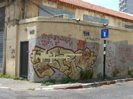
Wall paintings and signs in Jerusalem.
© Marisa Polin

wall painting